About 139 minutes
The Ashes of a God — Background and Themes
Folklore
31,755 recorded words. 2 minutes difference from this book's estimate.
View Gutenberg source #48909
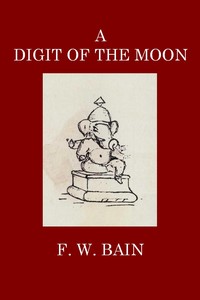
Before opening A Digit of the Moon: A Hindoo Love Story — Text and Context, the edition data offers a quick orientation: 32,403 words, 2 hr 21 min estimated reading time, and 4 detected text sections.
The text analysis averages about 19.9 words per sentence, while the detected sections provide another way to judge how the source is divided.
Project Gutenberg metadata also associates the work with “Fantasy fiction,” connecting these edition facts with the source record’s subject description.
Explore this collection
These alternatives are selected using recorded categories and estimated reading time.
About 139 minutes
Folklore
31,755 recorded words. 2 minutes difference from this book's estimate.
View Gutenberg source #48909About 134 minutes
Folklore
30,670 recorded words. 7 minutes difference from this book's estimate.
View Gutenberg source #51200About 132 minutes
Folklore
30,228 recorded words. 9 minutes difference from this book's estimate.
View Gutenberg source #42893Search stored excerpts and compare books → Choose by your preferences →
Choices use stored catalog measurements. Estimates vary with reading speed. A shared category is a catalog label, not a claim that two books have the same argument or literary quality.
Search reads excerpt text stored with this catalog and links to its associated Gutenberg record. The connection is stored in the site database; this tool does not recheck that every excerpt is word-for-word identical to that external record. Excerpt search does not cover every chapter and does not verify historical publication dates.
Catalog snapshot checked: 2026-09-26. Coverage: 97 public books, 97 available source excerpts.
Calculated from edition completeness, EPUB availability, text structure and catalogue metadata. Not a user rating.
Total of 100 points, scaled to a 2.5-5.0 range. Editions with an empty description or a missing EPUB file are not scored.
Public-domain source text
The source text is kept in the dedicated reader, separate from this catalogue record and its commentary.
The preface to the second edition of A Digit of the Moon offers a striking clue to the work's method: the author, F. W. Bain, presents a stanza that he claims illustrates how 'the ideas of a beautiful woman, the Moon, and the Sea dissolve and disappear into one another.' This dissolving view is not merely a thematic flourish but a structural principle. The book is presented as a translation from a Hindoo manuscript, part of a larger work called The Churning of the Ocean of Time. Within this frame, a king and a princess engage in a daily contest: the king's friend Rasakósha tells a story, and the princess must cap it with a counter-story or a clever retort. The excerpts show that the princess consistently wins, and the king's reactions oscillate between despair and adoration.
The narrative frame is built on a repeated pattern: each day, the king and Rasakósha appear before the princess, who is described in increasingly ornate terms—'clad in a purple robe, with a bodice of burnished gold.' The king is 'speechless and fascinated, under the spell of her beauty.' Rasakósha then launches into a story, and the princess responds, often with a smile that leaves the king 'bewildered.' The tension lies in the asymmetry: the king is utterly captivated, while the princess remains in control, both intellectually and emotionally. The excerpts show her winning on day 9, and the king's comment—'eight days are lost'—suggests a prolonged contest. The frame itself becomes a story of obsession, with the king's love bordering on idolatry.
The embedded tale from day 9 concerns a merchant whose wife abandons him for a series of lovers. The merchant's devotion is absolute: 'he loved her more than his own soul.' Yet the wife 'despised him for it.' The story traces her descent through multiple paramours, culminating in a scar from a ring. The princess's response is not given in the excerpt, but the preface hints at a philosophical turn: 'men judge by the fallacious testimony of the senses, but the gods judge by the heart.' This suggests that the princess's counter-argument may involve illusion or intention. The tale itself is morally ambiguous—the merchant's forgiveness is portrayed as both noble and foolish, and the wife's behavior is condemned but also explained by her nature.
Bain's prefatory note foregrounds the difficulty of translation: 'we lose, in a literal prose version, the reverberation, and the echo of the Sea.' He offers a poetic rendering that attempts to preserve the 'undertone.' This self-consciousness about language extends to the footnotes, which explain terms like 'Yama' and 'Chitragupta' and draw parallels to 'the Jew dog of the Middle Ages.' The text is peppered with Sanskrit-derived terms (kalpa, Shiwa) and philosophical asides. The 'dissolving view' operates at multiple levels: the merging of woman, moon, and sea in the stanza; the blurring of literal and metaphorical in the stories; and the interplay between the frame and the embedded tales. The reader is constantly reminded that this is a translation of a translation, a digit of a larger whole.
Readers should attend to the way Bain uses the frame to comment on the embedded stories, and vice versa. The king's infatuation and the princess's composure create a dynamic that mirrors the themes of the tales—love, illusion, and judgment. The footnotes and preface are not mere apparatus but integral to the work's meaning. Approach the text as a layered puzzle, where each story reflects on the others, and the 'dissolving view' is both a poetic device and a philosophical stance.
That moonlit contest of wits stayed with me long after, that strange dance between love and what we choose to see. It reminded me of a quieter companion, one that unfolds old myths like someone recalling a childhood afternoon rather than reciting lessons. Indian Nature Myths — Inside the Classic carries that same tender patience, as if the stories know they’ve been told many times before and still find something fresh in the telling.
Create a short personal record of your experience with this book.