About 132 minutes
The Guardians of the Columbia Mount Hood, Mount Adams and Mount St. Helens — Text and Context
Folklore
30,228 recorded words. 2 minutes difference from this book's estimate.
View Gutenberg source #42893
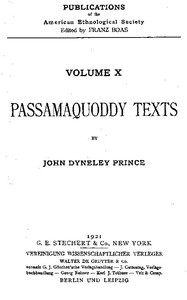
Passamaquoddy Texts — Context and Discussion can be approached with a clearer sense of reading commitment from its source measurements: 30,670 words, 2 hr 14 min estimated reading time, and 7 detected text sections.
The text analysis averages about 14.5 words per sentence, while the detected sections provide another way to judge how the source is divided.
Project Gutenberg metadata also associates the work with “Passamaquoddy Indians -- Folklore,” connecting these edition facts with the source record’s subject description.
Explore this collection
These alternatives are selected using recorded categories and estimated reading time.
About 132 minutes
Folklore
30,228 recorded words. 2 minutes difference from this book's estimate.
View Gutenberg source #42893About 132 minutes
Folklore
30,262 recorded words. 2 minutes difference from this book's estimate.
View Gutenberg source #53506About 139 minutes
Folklore
31,755 recorded words. 5 minutes difference from this book's estimate.
View Gutenberg source #48909Search stored excerpts and compare books → Choose by your preferences →
Choices use stored catalog measurements. Estimates vary with reading speed. A shared category is a catalog label, not a claim that two books have the same argument or literary quality.
Search reads excerpt text stored with this catalog and links to its associated Gutenberg record. The connection is stored in the site database; this tool does not recheck that every excerpt is word-for-word identical to that external record. Excerpt search does not cover every chapter and does not verify historical publication dates.
Catalog snapshot checked: 2026-09-26. Coverage: 97 public books, 97 available source excerpts.
Calculated from edition completeness, EPUB availability, text structure and catalogue metadata. Not a user rating.
Total of 100 points, scaled to a 2.5-5.0 range. Editions with an empty description or a missing EPUB file are not scored.
Public-domain source text
The source text is kept in the dedicated reader, separate from this catalogue record and its commentary.
This volume presents Passamaquoddy narratives in the original language with facing English translations, a format that foregrounds the linguistic structure of the tales. The compiler, John Dyneley Prince, was a linguist who worked within the early twentieth-century tradition of salvage ethnography, as indicated by the preface's classification of Passamaquoddy as part of the Wabanaki group. The excerpts reveal a consistent pattern: Kuloskap, a central figure, encounters animals and natural forces—a great bird named Wuchowsen, a turtle named Mikchich, and ice-giants—in episodes that explain origins or impose order. The texts are organized into series, with the first series devoted to wampum records and later ones to trickster tales and songs.
The texts are printed with the Passamaquoddy original on the left and an English translation on the right, often with interlinear glosses in parentheses. For instance, the phrase w't-iyun: "musumī, katama k't'makithumauyik k'wasis'k" is followed by the translation "He says to him: 'Grandfather, you have no mercy on your children.'" This layout allows readers to compare sentence structures directly. The preface notes that the Passamaquoddy-Maliseet speech was still used by about seven hundred people at the time of publication, situating the work as a documentation of a living but endangered language. The linguistic apparatus includes variant readings marked kesena ("or"), as in w'toluk (kesena: w't-ekwitn'muk), showing Prince's attention to dialectal or idiolectal variation.
The excerpts center on Kuloskap, who interacts with animals and natural forces in ways that blend authority with humor. In the episode with the great bird Wuchowsen, Kuloskap rebukes him for causing storms, then physically subdues him: he "takes along that great bird, as if he were a duck, and he ties his wings together and throws him down where it is split (between) two great rocks." This act of binding a chaotic force echoes a common motif in Algonquian folklore. In another tale, Kuloskap interprets a baby's cries as meaning "eggs," leading to the discovery of turtle eggs—a jest that the text says is commemorated by turtles laying eggs "even to this day." The narratives thus serve both as entertainment and as etiological explanations for natural phenomena.
The catalog lists "Passamaquoddy Indians -- Folklore" and "Passamaquoddy language -- Texts" as subjects. The excerpts confirm that the volume is indeed a collection of folklore, but they also reveal a strong emphasis on the figure of Kuloskap, who appears in multiple series. The preface's linguistic classification and the inclusion of songs (Series 4) broaden the scope beyond simple folktales. Notably, the first series is titled "The Wampum Records," suggesting a historical or ceremonial dimension not fully represented in the excerpts. The catalog does not mention the bilingual format or the detailed linguistic notes, which are central to the work's scholarly value. Readers expecting only English narratives will find instead a text that demands engagement with the original language.
Readers should approach this volume as a primary source for both folklore and linguistics. The bilingual layout rewards those who compare the Passamaquoddy and English versions, while the preface and footnotes provide context on dialect and transcription. The tales of Kuloskap offer a window into Wabanaki cosmology, but the incomplete excerpts leave many episodes—such as the wampum records and songs—unexplored. Treat the text as a record of oral tradition filtered through early twentieth-century scholarly conventions.
I found myself thinking of an old notebook while reading Passamaquoddy Texts, especially the quiet way Kuloskap speaks to the animals. There is something familiar in that patient exchange, how meaning rests between words. It brought Wurra-Wurra — A Closer Reading to mind, another book where listening matters more than understanding at first. A small echo, really.
Use these questions to collect your thoughts before moving on.