About 210 minutes
Psyche — Context and Discussion
Fairy Tales
48,187 recorded words. 19 minutes difference from this book's estimate.
View Gutenberg source #38005
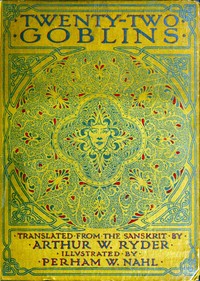
The catalog record for Twenty-Two Goblins. Translated from the Sanskrit — A Closer Reading provides practical reading context through 43,707 words, 3 hr 11 min estimated reading time, and 27 detected text sections.
The text analysis averages about 15.3 words per sentence, while the detected sections provide another way to judge how the source is divided.
Project Gutenberg metadata also associates the work with “Tales -- India,” connecting these edition facts with the source record’s subject description.
Explore this collection
These alternatives are selected using recorded categories and estimated reading time.
About 210 minutes
Fairy Tales
48,187 recorded words. 19 minutes difference from this book's estimate.
View Gutenberg source #38005About 124 minutes
Fairy Tales
28,308 recorded words. 67 minutes difference from this book's estimate.
View Gutenberg source #52402About 103 minutes
Fairy Tales
23,620 recorded words. 88 minutes difference from this book's estimate.
View Gutenberg source #44447Search stored excerpts and compare books → Choose by your preferences →
Choices use stored catalog measurements. Estimates vary with reading speed. A shared category is a catalog label, not a claim that two books have the same argument or literary quality.
Search reads excerpt text stored with this catalog and links to its associated Gutenberg record. The connection is stored in the site database; this tool does not recheck that every excerpt is word-for-word identical to that external record. Excerpt search does not cover every chapter and does not verify historical publication dates.
Catalog snapshot checked: 2026-09-26. Coverage: 97 public books, 97 available source excerpts.
Calculated from edition completeness, EPUB availability, text structure and catalogue metadata. Not a user rating.
Total of 100 points, scaled to a 2.5-5.0 range. Editions with an empty description or a missing EPUB file are not scored.
Public-domain source text
The source text is kept in the dedicated reader, separate from this catalogue record and its commentary.
The frame story of Twenty-Two Goblins is deceptively simple: a king must carry a goblin from a sissoo tree to a cemetery, and the goblin tells a story each time, ending with a question. But the translator Arthur W. Ryder’s diction reveals a deliberate, almost legalistic precision. The goblin’s questions are phrased as formal dilemmas—"Whose fault was the resulting death?" or "Which is the more deserving?"—and the king’s answers are reasoned, citing evidence from the tale. This structure turns each story into a miniature courtroom debate, where the reader is invited to weigh competing claims.
The goblin speaks with a blunt, almost conversational tone that contrasts with the formal frame. He addresses the king as "O King" and uses imperative verbs: "Listen." His stories are introduced with a single sentence summary, then plunge into action. For example, the thirteenth goblin begins: "There is a city called Ayodhya, which was once the capital of Rama the exterminator of giants." This directness, combined with the ironic situation—a goblin lecturing a king on ethics—creates a dry humor. The goblin never moralizes; he simply presents the facts and demands a verdict.
Each story follows a rigid pattern: the king catches the goblin, the goblin tells a tale, and the king answers a question. Yet within this repetition, Ryder’s translation varies the opening phrases. Some stories begin with a city name and its famous ruler, others with a character’s name and a defining trait. The first goblin story opens: "There is a city called Ayodhya, which was once the capital of Rama." The second: "There is a city called Benares." This formulaic start grounds each tale in a recognizable geography, but the variation in detail—such as "a strong-armed king named Hero-banner"—keeps the reader alert to new elements.
Dialogue in the goblin stories is sparse but pointed. Characters often speak only a few lines, yet those lines reveal their motives. In the thirteenth story, the thief says to the king: "Good! You are my friend. Come to my house." The thief’s immediate trust, based on a shared profession, shows his naivety. Later, the serving-maid warns: "Your Majesty, why have you come into the jaws of death?" Her use of "Your Majesty" reveals she knows the king’s identity, adding tension. Ryder’s translation preserves these brief exchanges, letting the characters’ words drive the plot.
Ryder’s descriptions are economical, focusing on one or two sensory details. The thief’s house is "hidden in a grove and guarded by a wall, full of delightful and beautiful things, and bright with shining gems." The phrase "bright with shining gems" is the only visual cue, but it suffices to convey wealth. In battle scenes, the description becomes kinetic: "He cut off the trunks of elephants, the legs of horses, and the heads of men." The parallel structure and concrete nouns create a rhythmic, almost cinematic violence. This restraint keeps the narrative moving swiftly.
Readers will find that the pleasure of Twenty-Two Goblins lies not in suspense but in the intellectual game of answering the goblin’s questions. Pay attention to how the king justifies his answers—he often cites a principle of justice or logic. The stories reward close reading of small details, as a single line can shift the moral calculus. Ryder’s translation, with its clean prose and careful phrasing, makes this ancient Sanskrit work feel immediate and sharp.
In the goblin’s riddles I always found a trickster’s patience, the kind that waits for a king to think before answering. It reminds me of how that cat, in The Adventures of Puss in Boots Marks's Edition — Reading Notes, also delights in clever turns. Both whisper that wit is a quiet, loyal companion.
Create a short personal record of your experience with this book.