About 16 minutes
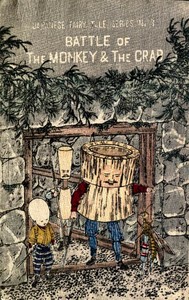
Battle of the Monkey & the Crab — Key Ideas to Explore
Fairy Tales
3,611 recorded words. 1 minutes difference from this book's estimate.
View Gutenberg source #25021
For The Adventures of Puss in Boots Marks's Edition — Reading Notes, the stored edition analysis reports 3,817 words, 17 min estimated reading time, and 1 detected text section.
The text analysis averages about 25.8 words per sentence, while the detected sections provide another way to judge how the source is divided.
Project Gutenberg metadata also associates the work with “Cats -- Juvenile poetry,” connecting these edition facts with the source record’s subject description.
Explore this collection
These alternatives are selected using recorded categories and estimated reading time.
About 16 minutes
Fairy Tales
3,611 recorded words. 1 minutes difference from this book's estimate.
View Gutenberg source #25021About 26 minutes
Fairy Tales
5,757 recorded words. 9 minutes difference from this book's estimate.
View Gutenberg source #11092About 81 minutes
Fairy Tales
18,525 recorded words. 64 minutes difference from this book's estimate.
View Gutenberg source #46338Search stored excerpts and compare books → Choose by your preferences →
Choices use stored catalog measurements. Estimates vary with reading speed. A shared category is a catalog label, not a claim that two books have the same argument or literary quality.
Search reads excerpt text stored with this catalog and links to its associated Gutenberg record. The connection is stored in the site database; this tool does not recheck that every excerpt is word-for-word identical to that external record. Excerpt search does not cover every chapter and does not verify historical publication dates.
Catalog snapshot checked: 2026-09-26. Coverage: 97 public books, 97 available source excerpts.
Calculated from edition completeness, EPUB availability, text structure and catalogue metadata. Not a user rating.
Total of 100 points, scaled to a 2.5-5.0 range. Editions with an empty description or a missing EPUB file are not scored.
Public-domain source text
The source text is kept in the dedicated reader, separate from this catalogue record and its commentary.
The verse form of this Marks's Edition gives the familiar tale a brisk, almost galloping rhythm. Each quatrain rhymes in an AABB pattern, and the lines are short—often eight or nine syllables—pushing the action forward without pause. The cat is called "Grimalkin" in the narrative, an archaic term that sets a folkloric tone, while the master remains unnamed until the cat invents the title "Marquis Carabas." The poem does not dwell on description; instead, it leaps from scene to scene: the warren, the wheat-field, the king's court, the Ogre's castle. This structural speed mirrors the cat's own quick movements and strategic timing.
The poem's meter is not perfectly regular—some lines have extra syllables or dropped beats—but the insistent rhyme keeps the story moving. For instance, the opening stanza ends "And so he resolv'd to kill that," with "that" forced into the rhyme scheme, suggesting a playful willingness to bend language for the sake of the couplet. This technique recurs: "Puss baited his bag with parsley and bread, / And away to a warren he hied." The rhymes often pair concrete objects with actions, grounding the fantasy in physical details. The repeated phrase "so gay" appears twice to describe the princess and the Ogre's castle, a small verbal echo that links the king's daughter and the Ogre's domain, perhaps hinting at the cat's ability to move between different social spheres.
The bag is the cat's primary tool, first baited with "parsley and bread" to catch a rabbit. The poem specifies the bait, a detail that makes the trick feel practical rather than magical. Later, the cat catches partridges in a "wheat-field," again using a real setting. The bag disappears after the initial hunts; the cat's later deceptions rely on threats (to the reapers) and flattery (to the Ogre). This shift from physical trap to verbal manipulation marks a progression in the cat's methods. The reapers are told to repeat a specific phrase—"To the Marquis Carabas these fields all belong"—or else be chopped "as small as minced meat." The threat is exaggerated, almost comic, and the poem does not show the reapers' reaction, leaving the reader to imagine their fear.
The Ogre's transformation scene is the poem's most concentrated moment of suspense. The cat challenges the Ogre's power by asking for a demonstration: "To convince you 'tis true, the Ogre replied, / I will change myself now in your sight." The Ogre becomes a lion, which frightens the cat—"Which put the poor cat in a fright"—a rare moment where the cat's composure cracks. The cat then goads the Ogre into becoming a mouse, and the poem dispatches the Ogre in a single line: "And sealed in an instant his doom." The transformation sequence is structured as a test: the cat doubts, the Ogre proves, the cat doubts again, and the Ogre overreaches. This pattern of challenge and response drives the scene, and the cat's fear makes the victory feel earned rather than effortless.
The poem's geography is a series of discrete locations, each introduced with a new stanza. The cat moves from a "warren" to a "wheat-field" to the king's court, then to a "cornfield" and finally to an "Ogre's grand castle." These spaces are not described in detail; they are functional stages for the cat's schemes. The castle is "opened by servants so gay," and the Ogre receives the cat "with kindness." The interior is a "spacious saloon" with a banquet "already spread." The poem does not explain how the cat prepared the banquet or why the servants obey—the gaps in logic are part of the fairy-tale structure. The final scene, the wedding, takes place offstage, reported in the last couplet: "And that day, 'PUSS IN BOOTS' gain'd greater renown, / For the marquis and princess were wed." The poem ends abruptly, with no moral or farewell.
This edition compresses a well-known story into 3817 words of verse, favoring action over explanation. Readers may notice how the poem skips the cat's boots entirely after the opening request—the boots are never mentioned again. The focus stays on the cat's speech and timing. Pay attention to the moments when the cat speaks directly to the king, the reapers, and the Ogre; each conversation advances the plot without interior reflection. The poem trusts its rhythm and rhyme to carry the tale, leaving the reader to fill in the spaces between stanzas.
There’s something tender about a creature who keeps changing shape to be loved, and I often think of that when I revisit Psyche — Context and Discussion. The cat’s climb and Psyche’s longing both feel like quiet searches for a home that understands us. Psyche — Context and Discussion stays with me that way, the way old stories do.
Your answers remain private and are stored only in this browser.