About 17 minutes
The Adventures of Puss in Boots Marks's Edition — Reading Notes
Fairy Tales
3,817 recorded words. 1 minutes difference from this book's estimate.
View Gutenberg source #37529
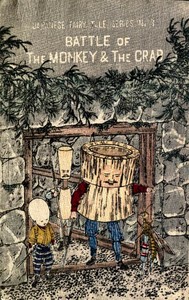
This digital edition of Battle of the Monkey & the Crab — Key Ideas to Explore is described by source-level measurements including 3,611 words, 16 min estimated reading time, and 1 detected text section.
The text analysis averages about 24.7 words per sentence, while the detected sections provide another way to judge how the source is divided.
Project Gutenberg metadata also associates the work with “Folklore -- Japan,” connecting these edition facts with the source record’s subject description.
Explore this collection
These alternatives are selected using recorded categories and estimated reading time.
About 17 minutes
Fairy Tales
3,817 recorded words. 1 minutes difference from this book's estimate.
View Gutenberg source #37529About 26 minutes
Fairy Tales
5,757 recorded words. 10 minutes difference from this book's estimate.
View Gutenberg source #11092About 81 minutes
Fairy Tales
18,525 recorded words. 65 minutes difference from this book's estimate.
View Gutenberg source #46338Search stored excerpts and compare books → Choose by your preferences →
Choices use stored catalog measurements. Estimates vary with reading speed. A shared category is a catalog label, not a claim that two books have the same argument or literary quality.
Search reads excerpt text stored with this catalog and links to its associated Gutenberg record. The connection is stored in the site database; this tool does not recheck that every excerpt is word-for-word identical to that external record. Excerpt search does not cover every chapter and does not verify historical publication dates.
Catalog snapshot checked: 2026-09-26. Coverage: 97 public books, 97 available source excerpts.
Calculated from edition completeness, EPUB availability, text structure and catalogue metadata. Not a user rating.
Total of 100 points, scaled to a 2.5-5.0 range. Editions with an empty description or a missing EPUB file are not scored.
Public-domain source text
The source text is kept in the dedicated reader, separate from this catalogue record and its commentary.
The tale begins with a straightforward barter: a monkey trades a persimmon-seed for a crab's toasted rice-cake. The crab plants the seed, which instantly grows into a towering tree full of persimmons. Unable to climb, the crab asks the monkey for help. The monkey, however, eats the ripe persimmons and throws the unripe ones at the crab, bruising his shell and forcing him into his hole. This initial betrayal sets the stage for a revenge plot that escalates far beyond a simple quarrel.
The opening exchange is notable for its asymmetry: the monkey wants something “that could be turned to good account at once,” while the crab gives up his rice-cake “without a word.” The monkey’s cunning is evident from the start, and the crab’s silent compliance hints at a trusting nature that will be exploited. The magical growth of the persimmon tree—springing up “at once” to a height requiring one to look up—introduces a folkloric element where actions have swift, exaggerated results. The monkey’s betrayal, throwing unripe fruit while pocketing the ripe ones, is a concrete act of malice that transforms the crab from a passive victim into a wronged party seeking justice.
After the crab’s relatives hear of his plight, they are “surprised and angry” and declare war. Yet the crabs find themselves outmatched by the monkey’s forces and retreat to hold a “council of war.” At this point, the story introduces four non-crab characters: a rice-mortar, a pounder, a bee, and an egg. These objects and creatures, typically associated with domestic life, become strategic allies. They “devised a deep-laid plot” to feign peace and lure the monkey into the crabs’ hole. The inclusion of such mundane items as active participants gives the tale a playful, cumulative quality reminiscent of other folktales where the weak band together against a stronger foe.
The monkey, unsuspecting, enters the hole and is seated on the hearth. When he uses the hibashi (poker) to stir the fire, a hidden egg explodes, burning his arm. He plunges his arm into a pickle-tub to cool it, only to be stung by a bee hidden there. Howling, he rushes for the back door, but sea-weed entangles his legs, causing him to slip. Then a pounder falls on him from a shelf, and a mortar rolls down from the roof, breaking his back. Each step of the trap is triggered by the monkey’s own actions—stirring, seeking relief, fleeing—making his downfall a direct result of his earlier greed and cruelty. The sequence is methodical and almost comical in its escalation.
Once the monkey is weakened and unable to rise, the crabs emerge “in a crowd” and “brandishing on high their pinchers they pinched the monkey to pieces.” The ending is stark and violent, with no reconciliation or lesson explicitly stated. The crab, who began as a victim, becomes part of a collective execution. The tale does not moralize; instead, it presents a cycle of betrayal and revenge where the initial wrong is repaid in kind, but with interest. The inclusion of the rice-mortar, pounder, bee, and egg as co-conspirators suggests that justice, in this world, is a communal effort that can turn everyday objects into weapons.
Readers should note how the story’s structure mirrors a classic folktale pattern: a deceptive trade, a magical reward, a betrayal, and a cumulative revenge. The abrupt shift from the crab’s passive suffering to the elaborate trap keeps the narrative brisk. Pay attention to the role of the four allies—each contributes a specific, physical harm that builds on the previous one. The tale’s brevity and directness make it a clear example of how Japanese fairy tales often blend the mundane with the fantastical to deliver a pointed, if unstated, lesson about fairness and retribution.
I keep thinking about that crab, gathering allies not for forgiveness but for justice with teeth. It feels less like a fairy tale and more like something we all learn slowly. Reading Psyche — Context and Discussion reminded me how often our deepest retaliations are really quiet pleas for recognition. Strange, how revenge and longing share the same small, stubborn heart.Psyche — Context and Discussion stays with me that way.
A brief reflection can help important ideas stay with you longer.