About 266 minutes
The Laughter of Peterkin: A retelling of old tales of the Celtic Wonderworld — Context and Discussion
Folklore
61,002 recorded words. 0 minutes difference from this book's estimate.
View Gutenberg source #50292
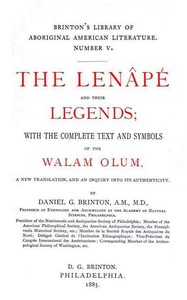
The catalog record for The Lenâpé and Their Legends With the complete text and symbols of the Walam olum, a new translation, and an inquiry into its authenticity — Inside the Classic provides practical reading context through 61,013 words, 4 hr 26 min estimated reading time, and 11 detected text sections.
The text analysis averages about 13.4 words per sentence, while the detected sections provide another way to judge how the source is divided.
Project Gutenberg metadata also associates the work with “Picture-writing, Indian,” connecting these edition facts with the source record’s subject description.
Explore this collection
These alternatives are selected using recorded categories and estimated reading time.
About 266 minutes
Folklore
61,002 recorded words. 0 minutes difference from this book's estimate.
View Gutenberg source #50292About 259 minutes
Folklore
59,454 recorded words. 7 minutes difference from this book's estimate.
View Gutenberg source #76929About 274 minutes
Folklore
62,899 recorded words. 8 minutes difference from this book's estimate.
View Gutenberg source #41437Search stored excerpts and compare books → Choose by your preferences →
Choices use stored catalog measurements. Estimates vary with reading speed. A shared category is a catalog label, not a claim that two books have the same argument or literary quality.
Search reads excerpt text stored with this catalog and links to its associated Gutenberg record. The connection is stored in the site database; this tool does not recheck that every excerpt is word-for-word identical to that external record. Excerpt search does not cover every chapter and does not verify historical publication dates.
Catalog snapshot checked: 2026-09-26. Coverage: 97 public books, 97 available source excerpts.
Calculated from edition completeness, EPUB availability, text structure and catalogue metadata. Not a user rating.
Total of 100 points, scaled to a 2.5-5.0 range. Editions with an empty description or a missing EPUB file are not scored.
Public-domain source text
The source text is kept in the dedicated reader, separate from this catalogue record and its commentary.
Daniel G. Brinton opens his study by situating the Walam Olum—a pictographic chronicle said to record Lenape migration and history—within a broader ethnological survey of the Delawares and neighboring tribes. He obtained the text in 1884 and immediately sought evaluations from educated native Delawares, including the Rev. Albert Anthony, whose linguistic judgment would become central to the authenticity debate. Brinton’s preface reveals a scholar aware of the document’s contested status: he notes that the original wooden tablets were reportedly procured in Kentucky in 1822 by Constantine S. Rafinesque, a figure whose scientific reputation was shadowed by accusations of fabrication. The volume thus proceeds as both a presentation of the Walam Olum and an inquiry into its genuineness, with Brinton weighing internal linguistic evidence against external skepticism.
Brinton devotes considerable space to Rafinesque’s character and methods. He describes Rafinesque as “poor, eccentric, negligent of his person, full of impractical schemes and extravagant theories,” and notes that he was excluded from Philadelphia’s learned societies. The author cites a refusal by Benjamin Silliman to publish Rafinesque’s work as early as 1819, and mentions that the linguist Peter Stephen Duponceau “wholly and deliberately ignored everything” by Rafinesque. These details establish a climate of distrust that Brinton must navigate. He does not dismiss the Walam Olum outright but instead applies a test: can the text be shown to contain genuine Lenape syntax beyond a mere word list? Rafinesque had access to published grammars by Zeisberger and Heckewelder, so stringing together Lenape words would have been easy; composing coherent sentences in the language would not.
Brinton’s key evidence comes from the Rev. Albert Anthony, a “well educated native Delaware, equally conversant with his own tongue and with English.” After studying the text, Anthony expressed “the positive opinion that the text as given was a genuine oral composition of a Delaware Indian.” He noted that in many lines “the etymology and syntax are correct,” while other lines contain “grammatical defects, which consist chiefly in the omission of terminal inflections.” Anthony’s explanation for these defects is that the person who wrote down the chants was “imperfectly acquainted with the native tongue” and did not always catch terminal sounds. This testimony, combined with Brinton’s own analysis, shifts the burden of proof: the text’s internal structure, rather than Rafinesque’s reputation, becomes the primary witness. Brinton also consulted other native Delawares, including the Rev. John Kilbuck, and corresponded with scholars such as Horatio Hale.
The volume includes the complete text and symbols of the Walam Olum, presented with a new translation. Brinton describes the document as a “Red Score” (from walam, meaning “painted” or “red”) consisting of pictographic signs accompanied by chants that were meant to be memorized. The text is organized in a series of verses, each associated with a symbol. Brinton’s translation attempts to render the Lenape into English while preserving the rhythmic and formulaic quality of the original. He also provides a facsimile of the symbols, allowing readers to examine the pictographs directly. The editorial apparatus includes notes on variant readings and discussions of difficult passages. Brinton’s approach is methodical: he treats the Walam Olum as a historical document whose authenticity must be tested, not assumed, and he lays out the evidence for readers to evaluate.
Readers approaching this work should attend to the interplay between Brinton’s ethnographic descriptions and his forensic analysis of the Walam Olum. The volume is as much about the process of authentication as it is about the Lenape themselves. Brinton’s willingness to publish the text despite lingering doubts—and to let native speakers’ judgments carry weight—makes this a revealing document in the history of American anthropology. The careful reader will note how Brinton balances his own skepticism with the evidence he has gathered, leaving the ultimate verdict open.
I keep thinking about how Brinton handled the Walam Olum—that mix of hope and doubt, wanting to believe the old story while checking every mark against itself. Revolutionary Reader: Reminiscences and Indian Legends — A Closer Reading carries a similar quiet ache, legends held gently even when proof feels thin. It stayed with me like a half-remembered voice, warm but unresolved.
Capture what you thought, learned, and would like to remember.