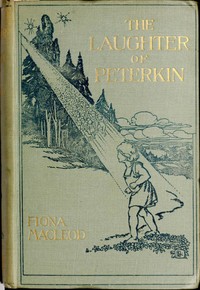
Fiona Macleod's The Laughter of Peterkin opens not with a mythic invocation but with a moonbeam that 'wriggled away, like a yellow eel'—a simile that grounds the supernatural in tactile, domestic imagery. The prose throughout the excerpts alternates between lyrical description and stark dialogue, as when Lu the Ildanna declares the terms of an eric with formal gravity. This editorial note examines three authorial choices visible in the text: the sensory texture of the frame narrative, the use of geas as a structural device, and the rhythm of oral storytelling preserved in the prose.
Sensory Diction in the Frame Narrative
The opening chapter establishes a world where light behaves like a living creature. The moonbeam 'glanced along a crescent tress on the pillow: sprang back like a startled bird: flickered hither and thither.' Macleod uses active verbs—'glanced,' 'sprang,' 'flickered'—to animate the natural world, blurring the boundary between the mundane and the wondrous. Peterkin's perception is rendered through simile: the poplar's leaves are 'ever-tremulous, ever-dancing, round little leaves,' and the stars are 'seven glittering eyes.' This technique persists in the mythic sections, where the 'Sweeper of the Waves' is described not as a boat but as a magical object won by wile. The diction consistently favors concrete, kinetic imagery over abstract description, inviting the reader to see the Celtic Wonderworld through a child's sensory awakening.
Geas as Narrative Engine
In 'The Fate of the Sons of Turenn,' the plot is driven by geasan—binding vows that characters cannot refuse. Lu is 'under geas not to refuse to play at chess when asked by any Dedannan,' and the sons of Turenn are 'under bond' to fulfill their eric. Macleod uses these obligations to create tension without relying on internal motivation: the heroes act because they must, not because they choose. The text explicitly states, 'honour is a better thing than ease,' but the narrative weight falls on the inescapable nature of the geas. This device structures the quest as a series of tasks, each more perilous, and the prose mirrors this with a cumulative, list-like syntax: 'after innumerable hardships, after fierce cold and fiercer heat, after hunger and thirst and daily perils.' The geas functions as both a cultural marker and a plot mechanism, giving the story a ritualistic, almost fated quality.
Oral Cadence and Embedded Narration
Macleod's prose retains the rhythms of oral storytelling. The frame narrative is told to Peterkin over multiple evenings, and the text explicitly acknowledges its own truncation: 'this tale cannot be told in full. To tell it aright would need a volume not less than this is.' This self-awareness mimics the performance of a storyteller who must abbreviate. Within the mythic sections, dialogue often carries the plot forward through formal pronouncements, as when Lu says, 'I do not think ye will find it easy to pass the sons of Mekween, nor to shout three shouts upon that hill.' The repetition of 'sons of Mekween' and the triadic structure echo traditional Celtic narrative patterns. Additionally, the use of 'ye' and archaic verb forms ('befit,' 'wilt') distances the language from everyday speech, reinforcing the sense of a tale from a distant, heroic age. The result is a hybrid voice that is both literary and oral, blending the intimacy of a fireside story with the grandeur of epic.
Illustrations as Narrative Counterpoint
The excerpts include references to Sunderland Rollinson's illustrations, which are listed in the contents and captioned with descriptive phrases: 'The King saw a Fountain of Exceeding Beauty' and 'A Great Raven, Glossy Black, and Burnished in the Sun Rays.' These captions function as miniature ekphrases, offering a visual counterpart to the text's sensory language. The frontispiece depicts a moment of wonder, while the illustration for 'The Fate of the Sons of Turenn' shows Turenn interceding for his sons—a scene of emotional weight. The interplay between word and image is suggested by the caption for the swan transformation: 'As she Touched Fionula, Lir's Fair Young Daughter Became a Beautiful Snow-white Swan.' This phrasing mirrors the prose's tendency to transform the ordinary into the magical through touch and light. Readers may consider how the illustrations reinforce or depart from the text's diction, particularly in moments of metamorphosis or confrontation.
These excerpts reveal a work that is neither a simple transcription of folklore nor a wholly original fantasy. Macleod's choices in diction, structure, and narrative voice create a layered reading experience: the frame story invites a childlike wonder, while the mythic sections demand attention to the formal constraints of geas and honor. Readers attentive to the prose's sensory details and its oral cadences will find a text that rewards close reading, even as it acknowledges its own incompleteness. The Celtic Wonderworld is rendered not as a distant realm but as one that flickers into being through language, much like the moonbeam that first wakes Peterkin.
I keep thinking about how Peterkin’s laughter echoes through those old tales, almost like a stone skipping across still water. It reminded me of something quiet and circular, and later I found that same hush in Moon Lore — Reading Companion. There’s a gentleness there, a way of holding mystery without needing answers, that stayed with me long after I closed the page.