About 513 minutes
Rumanian Bird and Beast Stories Rendered into English — Reading Companion
Folklore
117,763 recorded words. 7 minutes difference from this book's estimate.
View Gutenberg source #43059
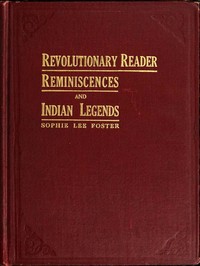
This digital edition of Revolutionary Reader: Reminiscences and Indian Legends — A Closer Reading is described by source-level measurements including 119,545 words, 8 hr 40 min estimated reading time, and 16 detected text sections.
The text analysis averages about 21.5 words per sentence, while the detected sections provide another way to judge how the source is divided.
Project Gutenberg metadata also associates the work with “Indians of North America,” connecting these edition facts with the source record’s subject description.
Explore this collection
These alternatives are selected using recorded categories and estimated reading time.
About 513 minutes
Folklore
117,763 recorded words. 7 minutes difference from this book's estimate.
View Gutenberg source #43059About 536 minutes
Folklore
123,158 recorded words. 16 minutes difference from this book's estimate.
View Gutenberg source #54616About 491 minutes
Folklore
112,896 recorded words. 29 minutes difference from this book's estimate.
View Gutenberg source #49872Search stored excerpts and compare books → Choose by your preferences →
Choices use stored catalog measurements. Estimates vary with reading speed. A shared category is a catalog label, not a claim that two books have the same argument or literary quality.
Search reads excerpt text stored with this catalog and links to its associated Gutenberg record. The connection is stored in the site database; this tool does not recheck that every excerpt is word-for-word identical to that external record. Excerpt search does not cover every chapter and does not verify historical publication dates.
Catalog snapshot checked: 2026-09-26. Coverage: 97 public books, 97 available source excerpts.
Calculated from edition completeness, EPUB availability, text structure and catalogue metadata. Not a user rating.
Total of 100 points, scaled to a 2.5-5.0 range. Editions with an empty description or a missing EPUB file are not scored.
Public-domain source text
The source text is kept in the dedicated reader, separate from this catalogue record and its commentary.
Sophie Lee Foster's Revolutionary Reader opens with a dedication to the Daughters of the American Revolution of Georgia, framing the work as a 'labor of love' rather than a detached scholarly history. The table of contents immediately signals a hybrid structure: alongside battle accounts and biographical sketches sit poems, a 'Revolutionary Puzzle,' and a section on 'State Flowers.' This mix of genres—prose, verse, and even a puzzle—suggests the book was designed for classroom use, as confirmed by endorsements from Lucian Lamar Knight and Joseph T. Derry printed in the front matter. Readers should expect a text that prioritizes patriotic sentiment and local color over strict chronological narrative.
The Reader does not proceed as a single continuous story. Instead, it assembles contributions from multiple authors, including Florence I. W. Burnham's poem 'Kitty' and T. H. Dreher's essay on the overlooked murder of Governor John Adams Treutlen. The poem uses concrete domestic objects—'a rare old plate with a portrait in blue, / Of England's George the Third'—to evoke Revolutionary memory through material culture. Dreher's prose, by contrast, adopts a theatrical tone, quoting Shakespeare and comparing Treutlen's death to Duncan's murder. This juxtaposition of lyrical and dramatic registers is a deliberate feature, not an inconsistency. Foster's editorial hand is light; she lets each piece retain its original voice, creating a mosaic effect that rewards readers who enjoy shifting perspectives.
Although the catalog subjects list 'United States -- History -- Revolution,' the excerpts concentrate heavily on Georgia. The contents include 'Forts of Georgia,' 'James Edward Oglethorpe,' 'The Condition of Georgia During the Revolution,' and 'Georgia State History, Naming of the Counties.' Dreher's account of Treutlen emphasizes his Salzburger heritage and his death at the hands of 'revengeful Tories.' This local focus means that events outside the South—such as the Battle of Lexington—are treated briefly, while obscure Georgia episodes receive extended treatment. Readers interested in the Revolution's regional diversity will find material here that mainstream histories often omit, but those seeking a national overview may need to supplement with other sources.
Poetry appears throughout the Reader as a vehicle for memory. Burnham's 'Kitty' catalogs heirlooms—a 'blanket one winter's night,' a 'clock, a bible worn'—and ties them to ancestral sacrifice. The poem's refrain 'There's a rare old plate with a portrait in blue' treats objects as repositories of family and national history. This approach aligns with the book's dedication to the DAR, an organization that often preserved relics and stories. Foster's inclusion of such verse suggests that emotional connection to the past was as important as factual accuracy. Readers should note that the poems are not decorative interludes but integral to the book's argument that everyday items carry revolutionary significance.
The excerpts do not reveal a continuous plot or a single argument. Dreher's essay, for instance, assumes knowledge of Treutlen's governorship and the 'cross-roads plot,' providing only a sketch of his life. The poem 'Kitty' offers no historical context for the objects it describes. Foster's compilation expects readers—likely schoolchildren or DAR members—to already possess a basic framework of Revolutionary events. This makes the Reader a supplement rather than a standalone text. First-time readers should approach it as a collection of primary sources and period pieces, each illuminating a different facet of how early 20th-century Georgians remembered the Revolution. The gaps between pieces are as instructive as the content itself.
Foster's Revolutionary Reader is best read not as a unified history but as a time capsule of early 20th-century patriotic education. Its mix of genres, local emphasis, and reliance on material culture offers a distinct perspective on how the Revolution was commemorated in the South. Readers should let the poems and anecdotes stand on their own terms, resisting the urge to force them into a single narrative. The book's value lies in its multiplicity of voices and its willingness to let contradictions—between poetic sentiment and grim historical detail—remain unresolved.
There’s something tender in how Foster’s reader holds onto voices that were already fading in 1913, the legends tucked beside the muster rolls. I felt that same ache turning through Wigwam Evenings: Sioux Folk Tales Retold — Reading Companion—not for what’s lost, but for the quiet way stories keep their warmth long after the tellers have gone.
Capture what you thought, learned, and would like to remember.