About 513 minutes
Rumanian Bird and Beast Stories Rendered into English — Reading Companion
Folklore
117,763 recorded words. 22 minutes difference from this book's estimate.
View Gutenberg source #43059
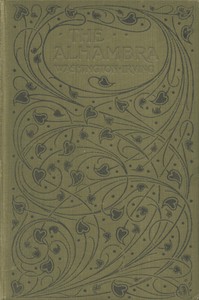
For The Alhambra — Reading Companion, the stored edition analysis reports 112,896 words, 8 hr 11 min estimated reading time, and 35 detected text sections.
The text analysis averages about 22.3 words per sentence, while the detected sections provide another way to judge how the source is divided.
Project Gutenberg metadata also associates the work with “Spain -- Social life and customs,” connecting these edition facts with the source record’s subject description.
Explore this collection
These alternatives are selected using recorded categories and estimated reading time.
About 513 minutes
Folklore
117,763 recorded words. 22 minutes difference from this book's estimate.
View Gutenberg source #43059About 520 minutes
Folklore
119,545 recorded words. 29 minutes difference from this book's estimate.
View Gutenberg source #46400About 455 minutes
Folklore
104,458 recorded words. 36 minutes difference from this book's estimate.
View Gutenberg source #44746Search stored excerpts and compare books → Choose by your preferences →
Choices use stored catalog measurements. Estimates vary with reading speed. A shared category is a catalog label, not a claim that two books have the same argument or literary quality.
Search reads excerpt text stored with this catalog and links to its associated Gutenberg record. The connection is stored in the site database; this tool does not recheck that every excerpt is word-for-word identical to that external record. Excerpt search does not cover every chapter and does not verify historical publication dates.
Catalog snapshot checked: 2026-09-26. Coverage: 97 public books, 97 available source excerpts.
Calculated from edition completeness, EPUB availability, text structure and catalogue metadata. Not a user rating.
Total of 100 points, scaled to a 2.5-5.0 range. Editions with an empty description or a missing EPUB file are not scored.
Public-domain source text
The source text is kept in the dedicated reader, separate from this catalogue record and its commentary.
Washington Irving’s The Alhambra opens with a traveler’s eye, not a historian’s lecture. The prose moves through the palace’s courts and gardens with a deliberate, unhurried pace, pausing to note the play of light on arabesques or the sound of water in a marble basin. Irving’s narrator is a guest, not a conqueror; he listens to the stories of Mateo and Dolores, and his descriptions are often filtered through their voices. The result is a text that shifts between precise architectural observation and the loose, anecdotal rhythm of oral tradition. Irving does not simply describe the Alhambra—he lets it speak through the people who live in its shadow, and his own sentences take on the patient, wondering tone of a man who has time to sit and listen.
Irving repeatedly hands the narration over to Mateo, a local guide whose speech patterns and beliefs shape whole passages. In one episode, Mateo points to a circular pit and recounts a family tradition: that it is an entrance to caverns where Boabdil and his court lie bound in magic spell. Irving’s response—a dry “It’s the same thing, Mateo”—reveals a gentle irony, but he does not dismiss the story. Instead, he lets Mateo’s grandfather’s eyewitness account of a hole where a pot had hung stand as a kind of proof. The guide’s language is colloquial, peppered with Señor and exclamations like “Que estrella hermosa!” Irving preserves these Spanish phrases, making the reader hear Mateo’s voice directly. This technique turns the guide into a co-author of the Alhambra’s legends, and the book’s authority rests as much on local testimony as on Irving’s own observation.
Irving’s descriptive passages often hinge on a single ritual or natural event. The sound of the evening prayer, a melodious signal that unites every human being throughout the land, spreads a transient sanctity over the scene. He notes that the effect is heightened by the wild and lonely nature of the place: the naked and broken summit of the haunted mountain, with ruined tanks and cisterns speaking of former populousness. The landscape is not static; it changes with the light and with human activity. As twilight deepens, the herdsmen and muleteers vanish, and only the lonely chirping of the cricket remains. Irving’s sentences lengthen to match the fading light, then contract when darkness falls. The Sierra Nevada’s snowy peaks glare against the dark blue firmament, and a single star appears, so pure and bright that Mateo bursts into Spanish praise. Irving remarks that the common people of Spain have a sensibility to natural objects, and he gives them the last word.
Irving’s prose in The Alhambra often mimics the cadence of a spoken tale. He uses simple conjunctions and repeated phrases: “and yet,” “and then,” “as we were wandering.” The sentences are cumulative, piling detail on detail like a storyteller who does not want to lose his thread. When Mateo tells the story of the enchanted pot, Irving transcribes it almost verbatim, with its false starts and digressions: “Ah, Señor, this mountain is full of wonders of the kind. In another place there was a hole somewhat like this, and just within it hung an iron pot by a chain; nobody knew what was in that pot, for it was always covered up; but everybody supposed it full of Moorish gold.” The repetition of “pot” and the chain of “but” clauses create a folkloric rhythm. Irving’s own voice, when it returns, is more polished but still retains a conversational ease. He does not elevate the guide’s speech into literary language; he lets it stand, and the contrast between the two registers gives the book its distinctive texture.
Irving’s Alhambra is not a silent monument. It is inhabited by people who cook, pray, tell stories, and point out holes where pots used to hang. The palace’s gardens are still watered, its fountains still run, and the governor’s apartments are lent to Irving as lodgings. This sense of ongoing life shapes every description. Irving notes the ruined tanks and cisterns, but he also hears the evening prayer and sees the fires made by men working on the Sierra Nevada. The past is not sealed off; it seeps into the present through Mateo’s tales and through the physical traces that Irving observes. He writes as a temporary resident, not a tourist, and his details—the star that seems close enough to touch, the cricket’s chirp—ground the Alhambra in a specific time of day and year. The book’s structure, moving from court to court and from legend to legend, mirrors the way a visitor might wander, pausing here and there, letting the place unfold at its own pace.
Readers who approach The Alhambra expecting a systematic guide or a single narrative will find instead a collection of moments, each anchored by a voice or a detail. Irving’s method is associative: a star prompts a remark on Spanish sensibility, a hole prompts a story about enchanted gold. The book rewards those who read slowly, attending to the shifts between Irving’s polished prose and Mateo’s vernacular, and who are willing to let the Alhambra reveal itself through its fragments and echoes.
Reading about Irving leaning close to Mateo’s firelit tales, I remembered my grandfather’s slow voice on winter evenings, spinning ghost stories from our own village. That same hush came back when I first opened Good Stories for Great Holidays Arranged for Story-Telling and Reading Aloud and for the Children's Own Reading — Background and Themes—not the words themselves, but the feeling of being handed something old, meant to be spoken, not just seen.
Capture what you thought, learned, and would like to remember.