About 276 minutes
Legends and tales of the Harz Mountains — Themes and Context
Fantasy Classics
63,261 recorded words. 11 minutes difference from this book's estimate.
View Gutenberg source #74323
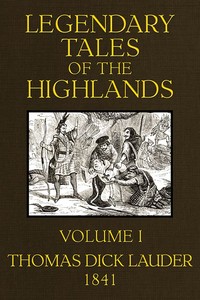
The catalog record for Legendary Tales of the Highlands (Volume 1 of 3) A sequel to Highland Rambles — Key Ideas to Explore provides practical reading context through 60,791 words, 4 hr 25 min estimated reading time, and 13 detected text sections.
The text analysis averages about 23.2 words per sentence, while the detected sections provide another way to judge how the source is divided.
Project Gutenberg metadata also associates the work with “Legends -- Scotland,” connecting these edition facts with the source record’s subject description.
Explore this collection
These alternatives are selected using recorded categories and estimated reading time.
About 276 minutes
Fantasy Classics
63,261 recorded words. 11 minutes difference from this book's estimate.
View Gutenberg source #74323About 241 minutes
Fantasy Classics
55,371 recorded words. 24 minutes difference from this book's estimate.
View Gutenberg source #35577About 290 minutes
Fantasy Classics
66,652 recorded words. 25 minutes difference from this book's estimate.
View Gutenberg source #36281Search stored excerpts and compare books → Choose by your preferences →
Choices use stored catalog measurements. Estimates vary with reading speed. A shared category is a catalog label, not a claim that two books have the same argument or literary quality.
Search reads excerpt text stored with this catalog and links to its associated Gutenberg record. The connection is stored in the site database; this tool does not recheck that every excerpt is word-for-word identical to that external record. Excerpt search does not cover every chapter and does not verify historical publication dates.
Catalog snapshot checked: 2026-09-26. Coverage: 97 public books, 97 available source excerpts.
Calculated from edition completeness, EPUB availability, text structure and catalogue metadata. Not a user rating.
Total of 100 points, scaled to a 2.5-5.0 range. Editions with an empty description or a missing EPUB file are not scored.
Public-domain source text
The source text is kept in the dedicated reader, separate from this catalogue record and its commentary.
Sir Thomas Dick Lauder opens Legendary Tales of the Highlands with a scene of deliberate, sensory-rich suspense. Patrick Stewart, scrambling like a goat down a precipice, navigates a landscape of 'rugged and angular fragments' and 'overthrown pine' branches broken by frequent passage. The prose dwells on the quality of darkness, the 'faint gleam of light' on moss-grown stone, and the 'hollow' murmur of voices from below. Lauder's authorial choice is to build tension through physical detail rather than psychological interiority: the reader follows Stewart's cautious steps, his halted listening, the smell of wood smoke, and the final drawing of his dirk. This is a narrator who trusts the landscape and the body's movements to carry the story.
Lauder's vocabulary for the Highland landscape is precise and tactile. He writes of 'precipice,' 'rugged slope,' 'angular fragments,' 'overthrown pine,' and 'superincumbent masses' piled from shattered crags. The passage is studded with verbs of cautious motion: 'scramble,' 'descend,' 'bend,' 'creep,' 'halt.' The narrator notes that the branches have been 'evidently broken away by frequent passage,' a detail that implies prior use without stating it. This attention to the physical evidence of movement—broken spray, worn stone—gives the setting a forensic quality. Lauder avoids generic 'forest' or 'mountain'; instead, he builds a specific, almost geological topography that the character must read and respond to.
The excerpt uses light and sound to structure the scene's suspense. Light appears in stages: first a 'faint gleam' on a stone's edge, then a 'brighter light' reflected from a second block, finally the 'rousing fire' within the cavern. Each increment of illumination corresponds to Stewart's approach and the reader's growing anticipation. Sound is similarly layered: a 'murmur like that of human voices,' then 'hollow' voices from a cavity, then 'distinctly heard voices' though words remain unintelligible. Lauder withholds full sensory clarity until the final reveal of the chamber. This graduated exposure is a deliberate authorial technique to control pacing and heighten the reader's immersion in Stewart's limited perspective.
The cavern is described as an 'irregularly-shaped chamber' with 'low passages of connection to other chambers,' a natural den whose smoke escapes through a 'crevice immediately over it.' Lauder emphasizes the hiddenness and complexity of the space: the entrance is formed by a 'natural entrance' under fallen rocks, the passage is 'low, narrow, gently ascending,' and the interior is revealed only piecemeal. The fire burns in a 'recess in the side of the rocky wall,' and 'dark holes' suggest further unseen depths. This architecture of concealment—a space that is both shelter and trap—reflects a recurring interest in the Highlands as a region of secret histories and concealed refuges. The narrator's eye for structural detail (the angle of light, the direction of passages) turns the cavern into a character in its own right.
Lauder's authorial presence is felt in the dedication and the note on the Argyll patronymic, where he corrects Sir Walter Scott's spelling of 'MacCallum More' to 'Mac Chailein Mhoir,' explaining the Gaelic orthography and pronunciation. This philological aside reveals a writer who sees himself as a custodian of accurate Highland tradition, not merely a storyteller. The dedication to the Duke of Argyll, invoking 'Mac Chailein Mhòr' as the name 'most fitted to be associated with Highland story,' positions the tales within a network of clan identity and scholarly correction. Lauder's narrative voice in the tales themselves, however, is less pedantic: it is the voice of a close observer of physical action and natural detail, one who trusts the landscape to generate meaning. The tension between the antiquarian frame and the vivid, sensory prose is a defining feature of the work.
Readers approaching Legendary Tales of the Highlands should attend to the interplay between Lauder's scholarly apparatus—the dedications, notes, and corrections—and the narrative passages themselves. The tales reward attention to physical description: the way a character moves through a glen, the quality of light in a cavern, the sound of voices from an unseen source. Lauder's prose is at its most effective when it trusts the landscape to convey mood and history, rather than explaining them outright. This volume invites a slow, sensory reading, one that follows the narrator's eye as it traces the broken branch, the gleam on stone, and the hollow echo of voices underground.
That rain kept drumming on the window while Lauder’s hero crept through the dark, and I felt that same wary thrill—old stories carried in a living voice. Later, idly browsing, I stumbled onto a volume of medieval romances where courtly lovers trade vows under sieges, yet the same earthy urgency pulses beneath. Aucassin & Nicolette, and Other Mediæval Romances and Legends — Edition Insights sat beside the Highland tales, and somehow the afternoon folded them together.
Capture what you thought, learned, and would like to remember.