About 639 minutes
Seneca myths and folk tales — Themes and Context
Fantasy Classics
146,913 recorded words. 240 minutes difference from this book's estimate.
View Gutenberg source #61477
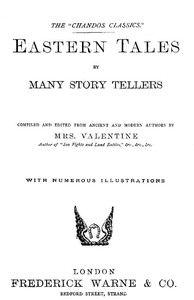
For Eastern Tales by Many Story Tellers — Key Ideas to Explore, the stored edition analysis reports 202,131 words, 14 hr 39 min estimated reading time, and 19 detected text sections.
The text analysis averages about 23.5 words per sentence, while the detected sections provide another way to judge how the source is divided.
Project Gutenberg metadata also associates the work with “Children's stories,” connecting these edition facts with the source record’s subject description.
Explore this collection
These alternatives are selected using recorded categories and estimated reading time.
About 639 minutes
Fantasy Classics
146,913 recorded words. 240 minutes difference from this book's estimate.
View Gutenberg source #61477About 406 minutes
Fantasy Classics
93,333 recorded words. 473 minutes difference from this book's estimate.
View Gutenberg source #56094About 338 minutes
Fantasy Classics
77,540 recorded words. 541 minutes difference from this book's estimate.
View Gutenberg source #38110Search stored excerpts and compare books → Choose by your preferences →
Choices use stored catalog measurements. Estimates vary with reading speed. A shared category is a catalog label, not a claim that two books have the same argument or literary quality.
Search reads excerpt text stored with this catalog and links to its associated Gutenberg record. The connection is stored in the site database; this tool does not recheck that every excerpt is word-for-word identical to that external record. Excerpt search does not cover every chapter and does not verify historical publication dates.
Catalog snapshot checked: 2026-09-26. Coverage: 97 public books, 97 available source excerpts.
Calculated from edition completeness, EPUB availability, text structure and catalogue metadata. Not a user rating.
Total of 100 points, scaled to a 2.5-5.0 range. Editions with an empty description or a missing EPUB file are not scored.
Public-domain source text
The source text is kept in the dedicated reader, separate from this catalogue record and its commentary.
Mrs. Valentine's Eastern Tales by Many Story Tellers opens with a father's deathbed warning to his son Jalaladdeen: 'a year has three hundred and sixty-five days, and the smallest expenditure, when it occurs daily, will in the end amount to no inconsiderable sum.' This practical arithmetic sets a tone of cautious morality that runs through the collection. The father bequeaths a rope with instructions to 'pull stoutly three times' if poverty strikes—a cryptic object that reappears later in the tale. The preface notes the editor has 'omitted a few words' from stories taken from the Tales of the Genii to suit youthful readers, signaling that these are adapted, not original, texts.
The opening tale, 'Jalaladdeen of Bagdad,' establishes a recurring tension between thrift and extravagance. The father's speech—'Provide that which is indispensable to thy subsistence; but beware of purchasing superfluities'—is a direct moral precept. Yet the story itself, like many in the volume, involves magical rewards and sudden wealth, creating a paradox: the narrative rewards the prudent hero while indulging in fantastical riches. The rope, a symbol of both suicide and rescue, embodies this duality. Later tales, such as 'The Four Talismans,' likely explore similar contrasts between material desire and spiritual wisdom, though the excerpts do not reveal their full resolutions.
The excerpt from 'Misnar, the Sultan of India' showcases a complex plot of feigned betrayal and hidden loyalty. Vizier Horam secretly constructs a pavilion with a 'massy stone' suspended by a rope through a golden pillar, a trap for enchanters. He confesses, 'I was resolved, in case my plot did not succeed, to bear the burden myself, that my Sultan's honour might not be lessened.' This self-sacrificing rhetoric contrasts with the giant Kifri's brutal punishment of the cowardly Prince Ahubal, whom he 'dashed against the rugged face of the mountains.' The story juxtaposes calculated loyalty with impulsive vengeance, both rendered in heightened, theatrical language.
The giant Kifri's rampage after the death of the enchanters illustrates a pattern of supernatural retribution. His 'broad eyeballs glowed like the red orb of day' and 'from his nostrils issued forth the tempest and the flame'—a vivid, almost elemental fury. Yet even he is haunted by dreams of the slain, suggesting that violence begets guilt. The editor's selection for 'youthful readers' does not soften these gruesome moments: Ahubal's 'mangled limbs, crushed by the fall, hung quivering on the pointed rocks.' The moral framework is clear—cowardice and treachery meet spectacular ends—but the excerpts leave open whether the collection consistently upholds this justice or allows for ambiguity.
Readers should note that the volume's 202,131 words span 19 sections, each likely varying in style and source. The editor's claim of 'great variety of style and subject' is borne out by the shift from the domestic caution of Jalaladdeen to the epic violence of Misnar. Pay attention to recurring objects—ropes, stones, rings—that function as plot devices and moral symbols. The tales reward attention to structural parallels rather than isolated incidents.
In that 1870s anthology, loyalty often flickered against betrayal like a candle in a drafty hall. I find myself returning to those old tales with the same fondness I hold for The Slayer of Souls — Edition Insights, whose darker corridors echo a similar battle between steadfast devotion and creeping shadows. They sit quietly together on my shelf, ancient and modern, whispering of courage worn softly.
Create a short personal record of your experience with this book.