About 103 minutes
An Essence of the Dusk, 5th Edition — Reading Companion
Folklore
23,463 recorded words. 5 minutes difference from this book's estimate.
View Gutenberg source #11499
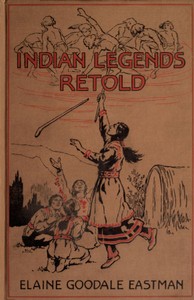
This digital edition of Indian Legends Retold — Key Ideas to Explore is described by source-level measurements including 24,835 words, 1 hr 48 min estimated reading time, and 4 detected text sections.
The text analysis averages about 20.9 words per sentence, while the detected sections provide another way to judge how the source is divided.
Project Gutenberg metadata also associates the work with “Indians of North America -- Folklore,” connecting these edition facts with the source record’s subject description.
Explore this collection
These alternatives are selected using recorded categories and estimated reading time.
About 103 minutes
Folklore
23,463 recorded words. 5 minutes difference from this book's estimate.
View Gutenberg source #11499About 102 minutes
Folklore
23,260 recorded words. 6 minutes difference from this book's estimate.
View Gutenberg source #70318About 118 minutes
Folklore
27,108 recorded words. 10 minutes difference from this book's estimate.
View Gutenberg source #28099Search stored excerpts and compare books → Choose by your preferences →
Choices use stored catalog measurements. Estimates vary with reading speed. A shared category is a catalog label, not a claim that two books have the same argument or literary quality.
Search reads excerpt text stored with this catalog and links to its associated Gutenberg record. The connection is stored in the site database; this tool does not recheck that every excerpt is word-for-word identical to that external record. Excerpt search does not cover every chapter and does not verify historical publication dates.
Catalog snapshot checked: 2026-09-26. Coverage: 97 public books, 97 available source excerpts.
Calculated from edition completeness, EPUB availability, text structure and catalogue metadata. Not a user rating.
Total of 100 points, scaled to a 2.5-5.0 range. Editions with an empty description or a missing EPUB file are not scored.
Public-domain source text
The source text is kept in the dedicated reader, separate from this catalogue record and its commentary.
The collection opens with an introduction by Charles A. Eastman (Ohiyesa), who describes how these legends were traditionally told by fireside to children, teaching lessons through humanized animals. He notes that the stories are "fragments of what were once consecutive and continued stories," and that they foster "a love of nature, reverence, a kindly spirit, and finally patriotism." This framing invites readers to approach the tales as remnants of a living oral tradition, not merely as folklore artifacts.
The first excerpt, "Raven and the Salmon Woman," introduces a trickster figure who gains a supernatural wife and loses her through jealousy and suspicion. The narrative voice is direct and economical, with dialogue driving the plot—Raven's wife warns him, "Remember, I am the Salmon Woman," before her magical ability to summon fish is revealed.
In "Raven and the Salmon Woman," the trickster Raven is initially fortunate: he acquires a wife who provides endless salmon. Yet his behavior follows a pattern of distrust and cruelty. He leaves his eye to guard the fish, loses it to birds, and then accuses his wife of infidelity based on his gambling luck. The story’s moral structure is explicit: when the Salmon Woman feels insulted, she calls her tribe of fish to life and departs, leaving Raven "alone and hungry once more." The tale thus reinforces the introduction’s claim that these legends bring "swift punishment for wrong-doing." Readers should note how the narrative balances humor—Raven’s absurd eye-watching scheme—with a clear ethical outcome.
The excerpt "The Animals in Council" shifts from individual trickster tales to a communal animal perspective. Grizzly Bear convenes a meeting of larger beasts—Deer, Elk, Wolf—to address the broken friendship between humans and animals. The proposal to petition He-Who-Made-Us for longer winters and deeper snows reflects a strategic, almost political response to human hunting. This story introduces a different narrative mode: collective decision-making and a shared grievance, contrasting with Raven’s solitary schemes. The language is formal, with Grizzly Bear making "his great speech," suggesting a ceremonial tone. Together, these excerpts show the collection’s range from domestic trickery to broader ecological commentary.
Throughout the excerpts, the supernatural is treated as ordinary. The Salmon Woman steps barefoot into a brook, and "instantly salmon by hundreds came leaping up the stream." Raven’s eye speaks, and later his wife restores it with a touch. The introduction explains this worldview: "It seems natural that an animal or even a rock should speak; God is in it and speaks through it." Readers should observe how the stories blend mundane details—building a hut, gathering wood, smoking fish—with miraculous events. This fusion reflects the introduction’s assertion that "mystery to the Indian is not mystery after all, but a reflection of the Great Mystery." The legends do not explain or justify the supernatural; they simply present it as part of life.
The prose is lean and action-oriented. Sentences are short, and events follow in quick succession: Raven builds a boat, a fog lifts, a woman appears, they marry, she summons fish. Dialogue is minimal but pointed—"Husband, come! the creek is full of silver salmon!"—and often carries the emotional weight. The stories avoid descriptive digression; setting is implied through action. This style aligns with the oral tradition described in the introduction, where tales were told aloud and learned by heart. Readers may notice repeated structural patterns: a character gains a gift, misuses it, and suffers consequences. The economy of language makes the legends accessible, while the moral patterns invite reflection on human behavior.
These excerpts offer a representative sample of the collection’s concerns: trickster morality, animal politics, and the seamless integration of the supernatural. Readers should pay attention to how each story’s ending reinforces a lesson, and how the introduction by Charles A. Eastman provides a cultural lens. The tales are best read not as isolated fables but as interconnected pieces of a worldview where animals speak, nature responds, and actions have clear consequences.
I finished Indian Legends Retold feeling the quiet weight of Raven’s lessons, how they linger like a familiar path at dusk. That same unhurried wisdom came back to me in Indian Legends from the land of Al-ay-ek-sa — A Reader’s Guide, where the stories feel less told than remembered. It was like meeting an old friend’s gentle echo.
Save your reaction, strongest insight, and memorable passage.