About 89 minutes
The Dolphin in History — Key Ideas to Explore
Folklore
20,276 recorded words. 8 minutes difference from this book's estimate.
View Gutenberg source #58939
The catalog record for Wigwam wonder tales — Inside the Classic provides practical reading context through 18,446 words, 1 hr 21 min estimated reading time, and 15 detected text sections.
The text analysis averages about 19.9 words per sentence, while the detected sections provide another way to judge how the source is divided.
Project Gutenberg metadata also associates the work with “Indians of North America -- Folklore,” connecting these edition facts with the source record’s subject description.
Explore this collection
These alternatives are selected using recorded categories and estimated reading time.
About 89 minutes
Folklore
20,276 recorded words. 8 minutes difference from this book's estimate.
View Gutenberg source #58939About 68 minutes
Folklore
15,502 recorded words. 13 minutes difference from this book's estimate.
View Gutenberg source #58463About 64 minutes
Folklore
14,494 recorded words. 17 minutes difference from this book's estimate.
View Gutenberg source #66884Search stored excerpts and compare books → Choose by your preferences →
Choices use stored catalog measurements. Estimates vary with reading speed. A shared category is a catalog label, not a claim that two books have the same argument or literary quality.
Search reads excerpt text stored with this catalog and links to its associated Gutenberg record. The connection is stored in the site database; this tool does not recheck that every excerpt is word-for-word identical to that external record. Excerpt search does not cover every chapter and does not verify historical publication dates.
Catalog snapshot checked: 2026-09-26. Coverage: 97 public books, 97 available source excerpts.
Calculated from edition completeness, EPUB availability, text structure and catalogue metadata. Not a user rating.
Total of 100 points, scaled to a 2.5-5.0 range. Editions with an empty description or a missing EPUB file are not scored.
Public-domain source text
The source text is kept in the dedicated reader, separate from this catalogue record and its commentary.
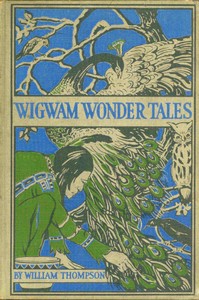
William Thompson's Wigwam wonder tales (1919) presents ten stories that the catalog classifies as "Indians of North America -- Folklore." The excerpts, however, show a more complex relationship between the tales and their claimed source. The dedication describes Thompson's travels from the Gulf of Mexico to the Arctic Ocean, but the stories themselves are set in a generalized "great northern wilderness" with specific place names like Lake Athabasca and Chipewyan. The narrative voice is consistently that of an outsider telling stories about Indians, not a traditional storyteller from within the culture.
The excerpts reveal a narrator who shifts between colloquial asides and formal description. In "Mr. Fish and Yoni," the fish "smiled so hard that three scales loosened" and then delivers a breezy farewell: "Good morning! ... and good-by! Long life and always happy days to you." This mix of anthropomorphic humor and abrupt departure is characteristic. Elsewhere, the narrator describes the Indian women's moccasins as "a charming adornment for the feet, even of a queen," a comparison that suggests an imagined audience unfamiliar with the craft. The tales are framed as wonder tales, not ethnographic records, and the narrator's voice consistently mediates between the world of the stories and the reader.
Several excerpts center on characters waiting or searching. Ani, in "Fire Boy and Water Boy," has lived alone on an island for nearly fifty years, calling each dawn and dusk for her lost lover. Yoni calls repeatedly for Mr. Fish, who has given him "Youth" and then departs for the sea. The dedication itself speaks of a ten-year companionship with H.T., a dog, across many landscapes. This pattern of separation and yearning runs through the tales, though the excerpts do not reveal whether these threads resolve. The stories seem to balance the comic antics of figures like the Fire and Water Boys with a quieter, melancholic undertone.
The list of illustrations offers a visual index of key moments: a mouse offering to release the sun, a giant frog standing on a man's foot, a man falling asleep under a tree that later becomes bare. Carle Michel Boog's illustrations, described in captions like "There will be no living with him," said the crow," suggest a tone of wry humor. The frontispiece shows a crow speaking, and several images depict animals in human-like poses. The illustrations are not reproduced in the text excerpts, but their captions hint at a visual storytelling style that complements the text's blend of the wondrous and the everyday.
The catalog subject "Indians of North America -- Folklore" implies a collection of traditional tales, but the excerpts show Thompson's own narrative framing. The dedication and the author's note (not fully excerpted) suggest a personal, even autobiographical, lens. The stories include place names like Chipewyan and Athabasca, but the narrative voice is that of an early 20th-century American writer, not a Native storyteller. Readers should approach these tales as literary adaptations rather than direct transcriptions of oral tradition. The wonder lies in Thompson's imaginative synthesis, not in ethnographic fidelity.
These tales reward attention to their narrative frame: the voice that introduces each story, the recurring motifs of calling and waiting, and the interplay between text and illustration. The excerpts offer glimpses of a world where animals speak, transformations occur, and human emotions are rendered in simple, direct language. Readers interested in early 20th-century American children's literature or the adaptation of Native American themes will find much to consider in Thompson's work.
Those old tales from Athabasca linger like northern dusk, that ache of wanting woven through trickster’s grin and spirit’s sigh. I find that same quiet pulse in Traditions of the Arikara — how a people’s memory holds both hunger and humor. The Traditions of the Arikara — Key Ideas to Explore sit beside Thompson’s pages like brothers by a shared fire, speaking in low, patient voices.
Capture what you thought, learned, and would like to remember.