About 301 minutes
The Turquoise Story Book: Stories and Legends of Summer and Nature — Context and Discussion
Folklore
69,066 recorded words. 5 minutes difference from this book's estimate.
View Gutenberg source #53033
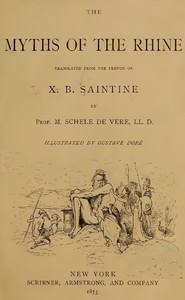
The catalog record for Myths of the Rhine — Reading Companion provides practical reading context through 70,236 words, 5 hr 6 min estimated reading time, and 13 detected text sections.
The text analysis averages about 23.3 words per sentence, while the detected sections provide another way to judge how the source is divided.
Project Gutenberg metadata also associates the work with “Mythology, Germanic,” connecting these edition facts with the source record’s subject description.
Explore this collection
These alternatives are selected using recorded categories and estimated reading time.
About 301 minutes
Folklore
69,066 recorded words. 5 minutes difference from this book's estimate.
View Gutenberg source #53033About 329 minutes
Folklore
75,612 recorded words. 23 minutes difference from this book's estimate.
View Gutenberg source #13500About 329 minutes
Folklore
75,636 recorded words. 23 minutes difference from this book's estimate.
View Gutenberg source #27228Search stored excerpts and compare books → Choose by your preferences →
Choices use stored catalog measurements. Estimates vary with reading speed. A shared category is a catalog label, not a claim that two books have the same argument or literary quality.
Search reads excerpt text stored with this catalog and links to its associated Gutenberg record. The connection is stored in the site database; this tool does not recheck that every excerpt is word-for-word identical to that external record. Excerpt search does not cover every chapter and does not verify historical publication dates.
Catalog snapshot checked: 2026-09-26. Coverage: 97 public books, 97 available source excerpts.
Calculated from edition completeness, EPUB availability, text structure and catalogue metadata. Not a user rating.
Total of 100 points, scaled to a 2.5-5.0 range. Editions with an empty description or a missing EPUB file are not scored.
Public-domain source text
The source text is kept in the dedicated reader, separate from this catalogue record and its commentary.
Saintine opens Myths of the Rhine by positioning himself as an "ignoramus and a pilferer," gleaning from scholars rather than claiming their authority. He likens his method to a bee collecting from a botanical garden without knowing Latin names. This self-deprecating frame sets the tone for a work that treats myth as a living, alluvial deposit along the Rhine's banks—each layer of belief, from Celtic tree-worship to Roman syncretism and Norse Eddas, piled atop the last. The author insists his aim is simply to retell "Grandmamma's Tales," noting that Edda itself means "grandmother."
Saintine repeatedly disavows scholarly pretension. He writes, "I am too great a lover of tales of a tub ever to have claimed the reputation of being a scholar; but at times I like to glean a little where scholars have reaped." This stance is not mere modesty; it shapes the book's structure. The descriptive table of contents reads like a catalog of curiosities—"Microscopic Deities," "A Goddess the Mother of Four Oxen," "The God of Cherries and the God of Bees." The author's voice remains conversational, even when tackling comparative mythology. He compares Odin's emanations to the Hindu god Buddha, and notes that Celts and Scandinavians believed in metempsychosis like Indians. Yet he undercuts any grand theory by calling his work "pilfering." Readers should expect a meandering, anecdotal journey rather than a systematic treatise.
A key tension emerges when Saintine describes the Romans encountering Norse deities. Rather than conflict, the Romans "received him and his retinue of deities as old acquaintances," seeing in Odin a Jupiter and in Thor a "gallant Mars, somewhat sobered by a long residence in northern countries and excessive use of beer." The author mocks ancient historians like Tacitus and Plutarch for giving "currency to such childish stories, ignoring entirely the date of the Scandinavian religion." This passage reveals Saintine's critical eye: he presents the syncretism as a political and poetic convenience, not a historical fact. The Romans, he notes, permitted no human sacrifices, so Odin's priests retreated "far from the beaten track." The excerpt leaves the outcome of this religious collision unresolved, but the pattern of adaptation and concealment is clear.
Saintine anchors his method in the etymology of Edda, which he claims means "grandmother." This framing recurs throughout the excerpts: he wants to tell "once more Grandmamma's Tales." The book's chapters move from primitive times through Druids, Roman gods, and Odin's pantheon, but the author consistently returns to a folklorist's delight in odd details. He notes that the Edda's prophecies of Ragnarok were "far from being near their fulfillment" when Romans arrived, and that Odin "had a long period of omnipotence yet before him." The tone is playful, even when describing the "Twilight of the Gods." Saintine's voice—self-aware, ironic, and fond of digression—makes the work feel like a fireside chat. Readers should approach it as a collection of stories stitched together by a narrator who values curiosity over coherence.
Saintine's Myths of the Rhine rewards readers who enjoy a narrator who winks while he works. The book's value lies not in its scholarly rigor but in its lively procession of deities, rituals, and cultural collisions. Doré's illustrations—though not excerpted here—likely amplify the fantastical register. Treat the table of contents as a menu of marvels, and let the author's digressions carry you along. The work is best read as a cabinet of curiosities, not a definitive mythology.
Some evenings, I return to that Rhine companion with its old engravings and grandmotherly tangents, and I find myself thinking of another volume’s quiet smile. A Digit of the Moon: A Hindoo Love Story — Text and Context holds a similar secret: both feel less like lessons than like warm hands passing along a story, gently, without hurry.
A brief reflection can help important ideas stay with you longer.