
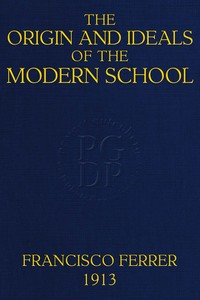
The Origin and Ideals of the Modern School by Francisco Ferrer Guardia
Let's be clear from the start: this isn't a novel. There's no protagonist's journey in the traditional sense. The 'story' here is the birth and struggle of a revolutionary idea.
The Story
Francisco Ferrer, haunted by the rigid, church-controlled education of his own Spanish childhood, lays out his vision for a completely different kind of learning. He founded the Escuela Moderna (Modern School) in Barcelona in 1901 as a living protest. The book is his explanation and defense of it. He argues that traditional education is a tool of oppression, used to make children submissive to authority and religious superstition. His school threw out the rulebook: mixed boys and girls, banned religious instruction, focused on science, hygiene, and rational thought, and treated students with respect. The drama comes from watching this peaceful, reason-based project ignite a firestorm of opposition from the government, the army, and especially the Catholic Church, who saw it as a direct threat to their power.
Why You Should Read It
I picked this up thinking it would be a dry historical document. I was wrong. Ferrer's passion is palpable. You can feel his frustration with a system designed to stifle curiosity and his genuine hope for a world built by critically thinking, compassionate people. What struck me most was how contemporary his complaints feel. The debate over what values schools should teach, the role of religion in public life, and whether education should prepare workers or free thinkers—it's all here, argued over a century ago. It's a powerful reminder that the fight for a better education system isn't new.
Final Verdict
This book is perfect for anyone interested in the history of education, radical political thought, or social change. It's also a great, quick read for modern teachers and parents questioning the status quo. If you enjoy seeing where revolutionary ideas come from, and you don't mind a book that's more of a passionate argument than a narrative, Ferrer's manifesto is a fascinating and surprisingly relevant piece of history. Fair warning: his fate (he was eventually executed by the state) hangs over the whole text, adding a layer of tragic urgency to his words.
This is a copyright-free edition. Knowledge should be free and accessible.
Joshua Moore
5 months agoI was skeptical at first, but the storytelling feels authentic and emotionally grounded. Thanks for sharing this review.
Donald Thompson
4 months agoI have to admit, the clarity of the writing makes this accessible. One of the best books I've read this year.




Nancy Taylor
7 months agoI appreciate the objective tone and the evidence-based approach.