
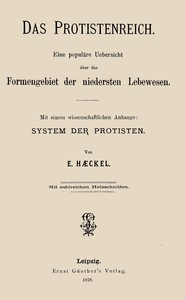
Das Protistenreich : eine populäre Uebersicht über das Formengebiet der…
Published in 1878, Das Protistenreich isn't a novel with a plot in the traditional sense. Think of it instead as an expedition log for a journey into a drop of water. Ernst Haeckel, a famous and sometimes controversial biologist, acts as your guide. His goal is straightforward: to catalog and explain the vast world of microscopic, single-celled life he calls the "Protist Kingdom."
The Story
The book is Haeckel's grand tour. He starts by defining what a protist is, separating these organisms from bacteria, plants, and animals. Then, he takes you through the different groups. You'll meet radiolarians with their glassy, geometric skeletons, amoebas that ooze and change shape, and lively paramecia darting through their miniature world. He describes how they find food, escape danger, and create new generations. The "story" is the revelation of complexity and beauty in what most people would dismiss as simple or insignificant. Haeckel builds his case, piece by detailed piece, that this is a legitimate and major branch on the tree of life.
Why You Should Read It
You should read this for the sense of wonder. Even today, with our high-tech microscopes, Haeckel's passion is infectious. He wasn't just writing for other professors; he genuinely wanted the public to see what he saw. His own drawings, which are a huge part of the book's legacy, are artistic masterpieces that blend scientific accuracy with a surreal, almost alien beauty. Reading his descriptions alongside those images makes the invisible world feel tangible and dramatic. It's a reminder that discovery isn't just about finding new continents, but about learning to see the continents that exist in a single water sample.
Final Verdict
This book is perfect for curious minds who love natural history, art enthusiasts fascinated by scientific illustration, and anyone who enjoys a good "hidden world" narrative. It's not a light beach read—it's a 19th-century scientific text—but Haeckel's engaging, popular style makes it far more accessible than you might think. If you've ever been amazed by a nature documentary, this is the 1878 equivalent. Be prepared for some outdated classifications (science has marched on), but read it for the awe, the art, and the powerful argument that there is always more to see, if only we look closely enough.
This historical work is free of copyright protections. It serves as a testament to our shared literary heritage.
James Young
1 year agoAfter hearing about this author multiple times, the atmosphere created is totally immersive. Absolutely essential reading.

George Thompson
1 year agoThis book was worth my time since it provides a comprehensive overview perfect for everyone. I couldn't put it down.