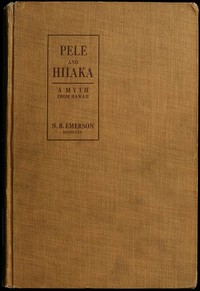
Emerson opens his preface with a striking admission: the myth of Pele and Hiiaka, he writes, 'stands at the fountain-head of Hawaiian myth and is the matrix from which the unwritten literature of Hawaii drew its life-blood.' Yet he immediately undercuts any claim to literary polish, noting that Hawaii 'was denied a Homer capable of voicing its greatest epic in one song.' This tension—between reverence for the source material and awareness of its fragmentary, multi-vocal transmission—shapes the entire volume. Emerson gathered his text from Hawaiian newspaper serials, interviews with elders, and solicited manuscripts, then supplemented it with ethnographic notes extracted 'by viva voce appeal to Hawaiians themselves.' The result is less a single narrative than a layered archive of a living tradition.
A Myth Assembled from Many Voices
Emerson makes no pretense of presenting a unified epic. He describes the myth as having been 'handled by many poets and raconteurs, each from his own point of view, influenced, no doubt, by local environment.' The text that follows bears this out: chapters shift between prose summary, chanted verse, and explanatory asides. In Chapter XXIV, for instance, Hiiaka announces her mission—'I have come to escort Lohiau as a lover to the bed of Pele'—in a formal, almost courtly register. But elsewhere the language turns earthy, as in the notes where Emerson glosses terms like eka mua ('the first blast of a storm; here used figuratively to mean the first sexual ecstasy') or describes the penalty for approaching Pele from behind: 'she is said to have had a consuming back.' The juxtaposition of high mythic diction and blunt physical detail is characteristic of the whole.
The Ethnographic Lens: Notes on Nature and Custom
Emerson's footnotes often overshadow the main narrative. They identify fish species (Hinalea akilolo, Gomphosus tricolor), describe fishing techniques (chewing bait and blowing it into the water), and explain taboos (the kiko, two ti leaves placed crosswise to mark a prohibition). One note traces the word Iku-wa as both a month name and a term for 'thunder and reverberations.' Another decodes the line Ho'o-nou o ka lani as referring to Pele 'striving to accomplish some physical task, as of a woman straining in labor.' These glosses do more than clarify; they embed the myth in a specific material world of fishing, farming, and bodily experience. The reader moves constantly between the supernatural drama and the practical knowledge of the Hawaiians who preserved it.
The Problem of a Single Authoritative Version
Emerson's preface explicitly laments the absence of a 'Homer' to harmonize the myth's variants. Yet his own editorial method—combining newspaper texts, oral interviews, and written submissions—inevitably produces a composite that is itself a new version. He acknowledges that local environment shaped each telling: the myth 'has been handled by many poets and raconteurs, each from his own point of view, influenced, no doubt, by local environment.' The reader encounters not Pele and Hiiaka but Pele and Hiiaka as filtered through a late-nineteenth-century collector's sensibility. Emerson's notes occasionally reveal his informants by name (e.g., 'Peleioholani' for the cave Ana-ku), hinting at a network of living authorities whose voices are now preserved only in these pages.
Readers should approach this book as a document of a tradition in transition, not as a fixed literary work. The myth's power lies in its gaps and contradictions—the moments when Emerson's scholarly apparatus cannot fully contain the living speech of his sources. Pay attention to the footnotes: they often carry the most vivid details, from the 'hairy, spotted crab, said to be poisonous' to the 'engulfing abyss' called Kai oki'a. The story of Pele and Hiiaka, as Emerson presents it, is finally a story about how stories are told, collected, and transformed.
I was rereading Emerson’s notes on Pele’s fiery temper, how the myth kept shifting with each teller, and it made me think of the Arikara earth—rooted, slow, patient. Different skies, yet both hold a people’s breath in their stories. My copy sits beside theirs now, quiet. Traditions of the Arikara — Key Ideas to Explore feels like a familiar evening, not a new one.