About 352 minutes
Poseidon's paradise: the romance of Atlantis — Story, Setting & Ideas
Folklore
80,896 recorded words. 2 minutes difference from this book's estimate.
View Gutenberg source #67921
The source record for Half-hours with the Highwaymen - Vol 1 Picturesque Biographies and Traditions of the "Knights of the Road" — Context and Discussion measures this digital text at 81,314 words, 5 hr 54 min estimated reading time, and 28 detected text sections.
The text analysis averages about 26.9 words per sentence, while the detected sections provide another way to judge how the source is divided.
Project Gutenberg metadata also associates the work with “Great Britain -- Social life and customs,” connecting these edition facts with the source record’s subject description.
Explore this collection
These alternatives are selected using recorded categories and estimated reading time.
About 352 minutes
Folklore
80,896 recorded words. 2 minutes difference from this book's estimate.
View Gutenberg source #67921About 359 minutes
Folklore
82,518 recorded words. 5 minutes difference from this book's estimate.
View Gutenberg source #2198About 361 minutes
Folklore
82,908 recorded words. 7 minutes difference from this book's estimate.
View Gutenberg source #43966Search stored excerpts and compare books → Choose by your preferences →
Choices use stored catalog measurements. Estimates vary with reading speed. A shared category is a catalog label, not a claim that two books have the same argument or literary quality.
Search reads excerpt text stored with this catalog and links to its associated Gutenberg record. The connection is stored in the site database; this tool does not recheck that every excerpt is word-for-word identical to that external record. Excerpt search does not cover every chapter and does not verify historical publication dates.
Catalog snapshot checked: 2026-09-26. Coverage: 97 public books, 97 available source excerpts.
Calculated from edition completeness, EPUB availability, text structure and catalogue metadata. Not a user rating.
Total of 100 points, scaled to a 2.5-5.0 range. Editions with an empty description or a missing EPUB file are not scored.
Public-domain source text
The source text is kept in the dedicated reader, separate from this catalogue record and its commentary.
Charles G. Harper's Half-hours with the Highwaymen opens not with a holdup but with a detailed account of Tyburn's shifting gallows. The author traces how the permanent scaffold, once a fixture at the junction of Oxford Street, Bayswater Road, and Edgware Road, was moved because new houses made the spectacle undesirable and traffic was blocked. Harper quotes the Gazetteer of 1771 to show that Lady Waldegrave's new house prompted relocation. This focus on the physical and social logistics of execution sets the tone for a work that treats highwaymen as products of their environment rather than romantic outlaws.
Harper's preface situates this volume within his larger series on British roads, coaching, and inns. He writes that a book on highwaymen was "sooner or later inevitable" given his prior works on road travel. The excerpts show that he approaches crime as an aspect of transport history: the highwayman is a figure who emerges from the same roads and inns Harper has already documented. The catalog subjects—"Roads—Great Britain" and "Crime—Great Britain"—are thus not separate categories but intertwined. Harper's method is to embed criminal biography within topographical and social description, as when he discusses Tyburn's location at a confluence of parishes. Readers familiar with his earlier books will recognize this blend of anecdote and antiquarian detail.
The excerpt on Tyburn reveals Harper's interest in the practical contradictions of public execution. He notes that highwaymen, who had obstructed roads in life, became "an equal nuisance" in death when their gallows blocked traffic. The permanent scaffold was replaced by a movable one, and Harper specifies the exact streets and squares where it stood, including No. 49 Connaught Square, citing the Bishop of London's lease. He then introduces Dr. Johnson's vehement opposition to ending the Newgate-to-Tyburn procession: "The age is running mad after innovation." Harper does not endorse Johnson's view but presents it as part of a debate about whether executions "answer their purpose" as deterrents. The passage ends by noting that public hangings continued at the Old Bailey until 1868, their deterrent value long disproven.
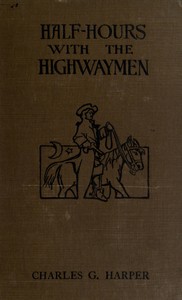
The title page promises illustrations by Paul Hardy, by the author himself, and from old prints. This visual component is integral to Harper's project of "picturesque biographies and traditions." The excerpts do not include images, but the text's descriptive passages—such as the detailed mapping of Tyburn's location—suggest a writer who thinks in spatial and visual terms. Harper's earlier works on roads and inns were also illustrated, and this volume continues that tradition. The catalog subject "Folklore" is apt: Harper is collecting and retelling traditions, not writing a criminological study. His highwaymen are figures of legend, but he grounds their stories in specific places and historical documents, creating a hybrid of travel writing, biography, and social history.
Readers approaching this volume should expect a leisurely, anecdotal narrative that moves between biography and topography. Harper assumes familiarity with his earlier road books, but the Tyburn section stands alone as a vivid case study of how crime and punishment were woven into London's urban fabric. The book's value lies less in its analysis of criminality than in its accumulation of period detail—the leases, the routes, the objections of Dr. Johnson. For those interested in the material culture of 18th-century crime, this is a rich source.
I keep thinking about that Harper book, how the highwaymen’s gallows bravado felt so heavy long after I closed it—the weight of a life summed up in one public moment. It reminded me oddly of an old tale I drifted through once, Maugis, ye sorcerer — Inside the Classic, where magic masks a lonelier sort of reckoning. Both lingered like a half-remembered face.
Use these questions to collect your thoughts before moving on.