
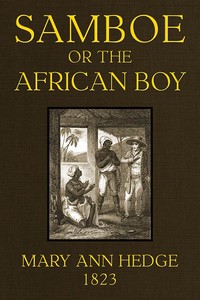
Samboe; or, The African Boy by Mary Ann Hedge
I recently picked up a copy of Mary Ann Hedge's Samboe; or, The African Boy, and it's one of those reads that sticks with you, partly because of its story and partly because of what it represents. Published in 1823, it's a slim volume that was clearly written with a purpose.
The Story
The book follows a young boy named Samboe. He lives a peaceful life in an African village until slavers violently tear him away. We see his terror and confusion as he's forced onto a slave ship, facing the horrific Middle Passage. The narrative then traces his life on a Caribbean plantation, detailing the harsh labor and the constant struggle to hold onto his sense of self and his memories of home. It's a straightforward, episodic plot that focuses on Samboe's suffering and resilience, designed to make the reader feel the human cost of slavery firsthand.
Why You Should Read It
This isn't just a historical novel; it's a historical artifact. Reading it, you're seeing the early 19th-century abolitionist movement in action. Mary Ann Hedge is using the popular tool of the moral tale to generate empathy for enslaved people. Her portrayal of Samboe as intelligent, feeling, and virtuous was a direct argument against the racist ideas used to justify slavery. It's not a perfect book by modern standards—the perspective is naturally limited by the author's own position—but its intent is powerful. It makes you think about the role of stories in social change. How do you get people to care about someone they've never met? For Hedge, the answer was to give that someone a name, a face, and a heart-wrenching story.
Final Verdict
This book is perfect for history buffs and literature students who want to understand the cultural weapons of the abolitionist fight. It's also for readers who appreciate seeing how genres like the moral tale or children's literature were used for serious political purposes. It's a challenging, sobering read due to its subject matter, but it's an important one. It reminds us that fiction has always had the power to try and reshape the world, for better or worse. Don't go in expecting a complex modern narrative; go in ready to engage with a piece of persuasive history.
This content is free to share and distribute. Distribute this work to help spread literacy.
Donald Williams
6 months agoThe clarity of the introduction set high expectations, and the case studies and practical examples provided add immense value. The price-to-value ratio here is simply unbeatable.
Patricia White
8 months agoMy first impression was quite positive because the clarity of the writing makes even the most dense sections readable. Simple, effective, and authoritative – what else could you ask for?
Michael Thomas
8 months agoRight from the opening paragraph, it addresses the common misconceptions in a very professional manner. This is a solid reference for both beginners and experts.
Linda Rodriguez
11 months agoAs someone working in this industry, I found the insights very accurate.



Robert Thompson
1 year agoThe layout of the digital version made it easy to start immediately, the way the author breaks down the core concepts is remarkably clear. I'm genuinely impressed by the quality of this digital edition.