About 55 minutes
The Story of Frithiof the Bold 1875 — Themes and Context
Myths Legends
12,465 recorded words. 8 minutes difference from this book's estimate.
View Gutenberg source #24420
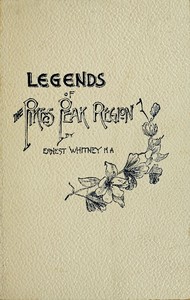
Legends of the Pike's Peak Region; The Sacred Myths of the Manitou — Key Ideas to Explore can be approached with a clearer sense of reading commitment from its source measurements: 10,732 words, 47 min estimated reading time, and 2 detected text sections.
The text analysis averages about 24.2 words per sentence, while the detected sections provide another way to judge how the source is divided.
Project Gutenberg metadata also associates the work with “Legends -- Colorado -- Pikes Peak Region,” connecting these edition facts with the source record’s subject description.
Explore this collection
These alternatives are selected using recorded categories and estimated reading time.
About 55 minutes
Myths Legends
12,465 recorded words. 8 minutes difference from this book's estimate.
View Gutenberg source #24420About 70 minutes
Myths Legends
16,031 recorded words. 23 minutes difference from this book's estimate.
View Gutenberg source #24421About 75 minutes
Myths Legends
17,176 recorded words. 28 minutes difference from this book's estimate.
View Gutenberg source #76755Search stored excerpts and compare books → Choose by your preferences →
Choices use stored catalog measurements. Estimates vary with reading speed. A shared category is a catalog label, not a claim that two books have the same argument or literary quality.
Search reads excerpt text stored with this catalog and links to its associated Gutenberg record. The connection is stored in the site database; this tool does not recheck that every excerpt is word-for-word identical to that external record. Excerpt search does not cover every chapter and does not verify historical publication dates.
Catalog snapshot checked: 2026-09-26. Coverage: 97 public books, 97 available source excerpts.
Calculated from edition completeness, EPUB availability, text structure and catalogue metadata. Not a user rating.
Total of 100 points, scaled to a 2.5-5.0 range. Editions with an empty description or a missing EPUB file are not scored.
Public-domain source text
The source text is kept in the dedicated reader, separate from this catalogue record and its commentary.
The preface to Legends of the Pike's Peak Region immediately establishes a comparative framework: the author likens Colorado's neglected traditions to Scotland's pre-Scott folklore, arguing that myths preserve "the very essence of their daily lives." This opening positions the collection as a recovery project, inviting readers to see the region's scenery through a legendary lens. The preface's reference to Scott's success in creating tourism suggests the author hopes for a similar cultural awakening.
The preface does not simply introduce the legends; it argues for their value by analogy. The author claims that "a ballad of the people, a bit of folk lore, may teach us more than whole chapters of history." This statement primes the reader to treat the following myths as serious cultural documents, not mere curiosities. The comparison to Scotland—once considered dull until Scott revealed its romance—implies that Colorado's stories carry similar potential. The preface thus functions as a persuasive essay, urging the reader to approach the tales with respect and expectation of hidden depth.
The middle excerpt traces a theological evolution. Initially, the Manitou's favor brings blessings: winter is revealed as beneficial, the sun returns, and wanderers come home. But discontent arises from a desire for "greater familiarity with the gods." The people request a continuous revelation, leading to the appearance of a "majestic and godlike Face" on the mountain. This face becomes a focal point of worship, yet it also creates dependency: the people cannot act unless the visible face looks favorably upon them. The narrative thus explores the tension between divine presence and human limitation.
The Great Face is the most striking recurring image. Described as "the mark of the symbol" already stamped on sun and moon, it unifies the cosmos. The legend emphasizes that the face is visible "far as the heaven-meeting peak could be seen," making the Manitou's presence constant yet conditional on clear weather. When clouds obscure the summit, the people fall into "sorrow and murmuring." This motif underscores the fragility of their faith and the literalness of their need for visible signs. The face becomes both a comfort and a limitation, driving the narrative forward.
The excerpts reveal a hybrid structure: the preface is analytical and historical, while the myths employ a formal, almost biblical cadence. Phrases like "the mountain shook and the hills and plains vibrated" create a tone of epic solemnity. The author occasionally inserts commentary—"the legend is careful to add"—which reminds the reader that this is a retelling. This dual voice allows the book to function both as a scholarly presentation and as a narrative collection. The shift from preface to myth is abrupt, but the consistent focus on the Manitou's relationship with the people provides continuity.
Readers should note that the excerpts break off before the embassy of priests reaches the gate of heaven, leaving the resolution unknown. The incomplete narrative invites speculation about how the people's petition is received. The book's value lies not only in the myths themselves but in the author's framing: he presents them as keys to understanding a landscape and a people. A first reading benefits from paying attention to the preface's arguments and the recurring symbols that bind the stories together.
Sometimes I still think about the Great Face in Whitney’s Manitou myths—how it watched over the people without ever speaking, a steady presence in the stone. It reminds me of something quieter in the old northern tales, where gods loom like weather rather than guides. Teutonic Mythology: Gods and Goddesses of the Northland, Vol. 3 — Background and Themes carries that same patient, distant weight, like a mountain you only notice once the noise settles.
Create a short personal record of your experience with this book.